2. The Man Trap – what it is and how it works
Rethinking Development, Masculinity, and Primary Prevention
Much of the work to prevent men’s violence against women has focused on masculinity.
Over the past two decades, the field of primary prevention has developed increasingly sophisticated ways of understanding how gender norms, power, entitlement, and socialisation contribute to harm. We now have a much clearer understanding of the attitudes and behaviours associated with violence, as well as the broader systems that reinforce them.
And yet, despite this progress, change can still feel slow, uneven, and difficult to sustain.
Many men are capable of articulating the “right” ideas about gender equality while still reproducing the same harmful patterns in relationships. Behaviour change can occur in one context but disappear in another. Reflection and insight do not always translate into deeper relational change. In some cases, prevention efforts themselves can become caught in cycles of defensiveness, performance, or ideological positioning that feel disconnected from meaningful transformation.
This raises an important question:
What if we are focusing on the right problem – but at the wrong level?
What if the issue is not masculinity itself, but something deeper that masculinity often expresses?
This essay introduces a different way of understanding the problem: the Man Trap.
The man trap is not a theory of masculinity. Nor is it a replacement for feminist understandings of gendered violence. Rather, it is an attempt to describe an underlying developmental pattern that may help explain why harmful behaviours emerge so consistently, why they are often gendered, and why efforts at change can struggle to reach beyond the level of behaviour and identity.
At its core, the man trap describes what happens when our understanding of the world becomes dominated by our individual perspective, while losing sight of how deeply connected and interdependent we are with others.
From within this pattern, a person continues to experience themselves as reasonable, justified, autonomous, and clear – even while important aspects of the situation remain outside their awareness.
The trap is not sustained through conscious intent. It is sustained by partial perception that feels complete from the inside.
The Missing Layer in Prevention Work
Much of primary prevention work focuses on changing:
attitudes,
beliefs,
behaviours,
social norms,
and constructions of masculinity.
This work matters. It has created essential shifts in public understanding and has helped make visible patterns that were once normalised or ignored.
But most of these approaches focus on the visible expressions of the problem, rather than the deeper orientation underneath it.
They focus on:
what men think,
how men behave,
how men understand masculinity,
and what kind of men they should become.
In practice, this often means encouraging men to:
reflect on their attitudes,
regulate harmful behaviours,
adopt healthier norms,
and develop more equitable identities.
But underneath all of this sits a deeper question that is rarely explored directly:
How does a person experience themselves in relation to others?
Because before behaviour occurs, before beliefs are articulated, before identity is consciously reflected upon, there is already a way of perceiving the world operating underneath.
There is already a structure through which situations are understood.
And if that structure itself remains unchanged, then many forms of change may remain fragile, situational, or performative – because the underlying orientation from which behaviour emerges has not shifted.
This is where the idea of social orientation becomes important.
Two Ways of Understanding Human Experience
Human beings develop through two fundamentally different, but equally necessary, ways of understanding their place in the world.
The first is an individual orientation.
The second is a relational orientation.
An individual orientation is the perspective through which a person experiences themselves as a distinct and autonomous individual. It is associated with agency, independence, identity, self-direction, and personal action.
This orientation is real and necessary. Without it, there is no stable sense of self. No capacity for independent thought. No personal responsibility or agency.
But there is also another side to human existence.
A relational orientation reflects the understanding that we do not exist in isolation, but in ongoing relationship and interdependence with others.
It is the perspective through which a person recognises:
mutual impact,
emotional and social interconnectedness,
dependence on networks of care and labour,
and the reality that one’s actions affect others in ways that extend beyond one’s own intentions.
This orientation is equally real and equally necessary.
Human maturity involves the capacity to hold both perspectives at the same time.
To experience oneself as both:
an individual,
and part of a larger relational reality.
The challenge is that these orientations do not always develop evenly. And when they become significantly imbalanced, patterns begin to emerge.
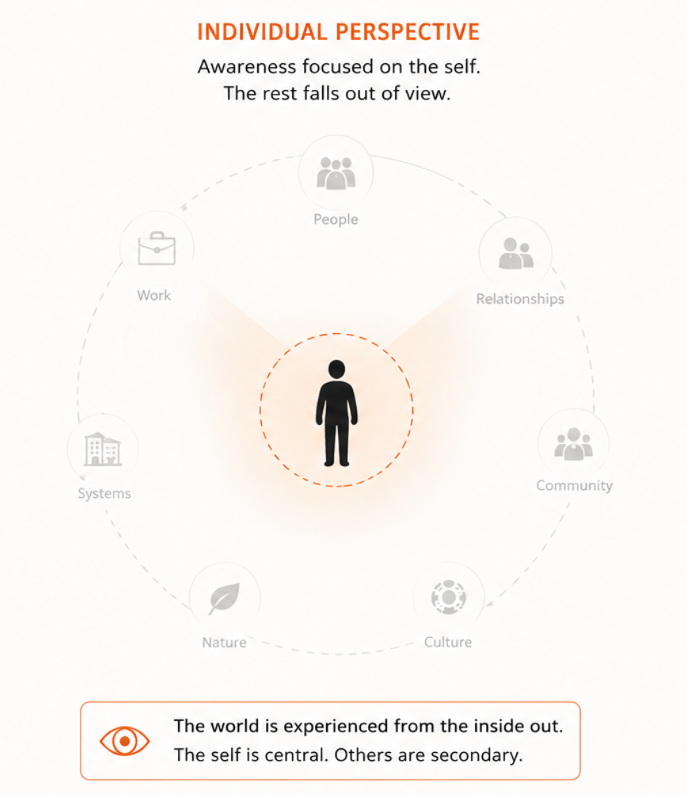
The man trap results from experiencing the world predominantly from an individual perspective
The Man Trap
The Man Trap is a self-reinforcing pattern of perception that emerges when a person’s understanding of the world becomes dominated by their individual perspective, while awareness of connection and interdependence with others begins to fall out of view.
From within this pattern, a person experiences their thoughts, intentions, and actions as reasonable and justified because they are grounded in what they can perceive and understand – even while important aspects of the situation remain outside awareness.
Because this way of seeing feels clear and sufficient from the inside, it continues to shape how situations are interpreted, how decisions are made, and how outcomes are understood.
When actions create effects beyond what can be easily seen – particularly in how they impact or are experienced by others – those effects are often missed, minimised, or reinterpreted through the same limited frame of understanding.
And this is what makes the pattern self-reinforcing.
A person acts from a partial understanding of the situation. The outcome still appears to confirm their original perspective. And so the same orientation continues to shape future behaviour. Over time, this can create a repeating pattern:
A person acts from what makes sense within their own perspective →
Something occurs outside that frame →
It is not fully recognised or understood →
The original perspective still feels correct →
The same response occurs again.
The man trap does not feel like a trap from the inside.
It feels like:
autonomy,
independence,
certainty,
being rational,
being justified,
being right.
And that is precisely why it can be so difficult to recognise.
How the Trap Forms
The man trap does not emerge all at once.
It forms gradually through development.
Early in life, the development of an individual orientation is both normal and necessary. Children learn to distinguish themselves from others. They develop identity, agency, independence, and self-direction.
But in many social contexts, boys are more consistently reinforced toward this side of development.
From an early age, boys are often encouraged to:
be self-reliant,
compete,
suppress vulnerability,
maintain control,
and prioritise independence.
These traits are frequently associated with maturity and strength.
At the same time, relational capacities are often less explicitly developed or reinforced.
Less attention may be given to:
emotional attunement,
mutuality,
relational impact,
interdependence,
and the experience of others as fully separate and significant in their own right.
This does not mean boys are incapable of relational awareness.
Nor does it mean men are inherently less relational.
The issue is developmental imbalance.
One orientation becomes stronger, more familiar, and more trusted, while the other remains less developed and less accessible under pressure.
Over time, this imbalance is reinforced through:
peers,
institutions,
social expectations,
cultural ideals of masculinity,
and wider systems that reward autonomy, control, and status.
As a result, the individual perspective increasingly comes to feel primary and sufficient.
The relational perspective remains present — but weaker, quieter, and easier to lose sight of.
How the Pattern Works
The Man Trap is not primarily a behavioural pattern. It is a perceptual pattern.
It shapes how situations are understood before it shapes how actions occur.
And because the pattern feels reasonable from the inside, it often goes unnoticed.
A man may enter conflict believing he is simply explaining himself clearly, while failing to recognise how his communication is landing relationally.
He may make decisions that feel rational and efficient from his own perspective, while remaining largely unaware of the emotional or relational consequences for others.
He may respond defensively to feedback because the impact being described sits outside the frame through which he understands the situation.
From within the trap, reactions often feel surprising:
“That’s not what I meant.”
“I was only trying to help.”
“I don’t understand why they reacted like that.”
“I was being reasonable.”
And in many cases, those statements are sincere. The issue is not necessarily dishonesty. The issue is that the person is working from a frame that experiences their own intentions, reasoning, and perspective as central and complete.
What sits outside that frame – particularly the lived experience of others – becomes harder to perceive with consistency.
This is why the same tensions often repeat:
misunderstanding,
defensiveness,
emotional disconnection,
entitlement,
coercion,
control,
relational invisibility.
Not because the person consciously intends harm at every moment. But because something essential remains outside awareness.
Why It Does Not Feel Like a Trap
One of the most important aspects of the man trap is that it does not feel restrictive from the inside.
It feels like freedom.
A person inside the trap still experiences themselves as:
thinking independently,
making rational decisions,
acting authentically,
and exercising personal agency.
There is no obvious feeling that something is missing. And because there is no clear sense of limitation, there is often no reason to question the frame itself.
This helps explain why prevention work can sometimes generate:
defensiveness,
resistance,
shame,
or disengagement.
If someone experiences themselves as fundamentally reasonable and autonomous, then attempts to challenge harmful behaviour can feel like attacks on identity rather than invitations into expanded awareness.
This also helps explain why some forms of behaviour change remain fragile.
A person may intellectually adopt new beliefs while still interpreting situations through the same underlying orientation.
In this sense, change can become:
cognitively understood,
but not deeply embodied.
The perspective remains largely individualised, even as the language changes.
Why Current Prevention Approaches Often Stall
This does not mean current prevention approaches are wrong. Much of the existing work is essential.
But the Man Trap suggests that many interventions operate at the level of:
norms,
beliefs,
identity,
and behaviour,
without fully addressing the deeper perceptual imbalance underneath them.
In some cases, prevention work may even unintentionally reinforce the same individual frame it is attempting to change.
Men are often asked:
What kind of man should you be?
What beliefs should you adopt?
How should you regulate yourself?
How can you perform healthier masculinity?
But these questions still centre the self as the primary site of orientation.
Even “healthy masculinity” can remain trapped within an individual frame if relational awareness itself does not fundamentally deepen.
This may help explain why:
some men become highly fluent in prevention language without substantial relational change,
some forms of accountability become performative,
and some behaviour changes collapse under stress or conflict.
Because beneath the surface, the same orientation remains intact.
The issue is not simply what a person believes.
It is how they perceive themselves in relation to others.
What This Means for Primary Prevention
If the challenge is developmental, then prevention may need to move beyond behaviour change alone.
This does not mean abandoning work on:
gender inequality,
social norms,
power,
accountability,
or masculinity.
But it may require recognising that sustainable change also depends on the development of relational perception itself.
This suggests a shift in emphasis: from changing what men think and do, toward expanding how they understand their place in the world and their connection and interdependence with others. In practice, this may involve:
creating environments that require mutuality rather than individual performance,
developing deeper relational awareness,
making interdependence visible,
strengthening the capacity to recognise impact,
embedding relational accountability into lived experience,
and supporting the ability to hold both individuality and interdependence simultaneously.
Importantly, this is not about dissolving individuality. The individual orientation remains essential. The task is balance.
The task is developing the capacity to remain grounded in oneself without losing sight of others as equally real and significant.
Beyond Masculinity
The man trap is not ultimately about masculinity. It is about imbalance.
Masculinity may shape how that imbalance develops and becomes reinforced, particularly for men. But the deeper issue is human.
It concerns what happens when one way of understanding human existence becomes dominant while another falls out of view.
From this perspective, violence, coercion, isolation, loneliness, emotional disconnection, and relational harm can be understood not simply as separate social problems, but as different expressions of the same underlying imbalance.
The challenge, then, is not to reshape masculinity. It is to support the development of a way of seeing in which both individuality and interdependence remain visible at the same time.
Because the deepest prevention work should not begin with teaching men how to be better men.
It should begin with helping people experience more fully that they are not separate from one another in the first place.