3. The Relational Perspective
Seeing Beyond the Individual Self in Primary Prevention
Much of the work to prevent men’s violence against women has focused on changing:
attitudes,
behaviours,
social norms,
and constructions of masculinity.
This work has been essential. It has helped make visible patterns of dominance, entitlement, coercion, emotional restriction, and gender inequality that were once minimised or normalised.
At the same time, there is an increasing recognition within the field that change can often feel partial, fragile, or difficult to sustain. Many men become capable of articulating the “right” ideas about gender equality while continuing to reproduce the same harmful relational patterns in practice.
In previous essays, I argued that many patterns associated with harmful masculinity can be understood as the overexpression of an individual perspective, unbalanced by a developed relational one.
But this raises an important question: What exactly is a relational perspective?
Because the term “relational” can easily become vague. It can sound therapeutic, emotional, moral, or ideological.
But the relational perspective described here is not simply about empathy, kindness, emotional openness, or softer masculinity. It reflects something much deeper.
Two Fundamental Human Realities
Human beings exist simultaneously in two ways.
We exist as individuals:
separate bodies,
separate minds,
separate centres of agency and experience.
But we also exist as participants in a profoundly interconnected human reality.
No human being comes into existence independently.
Every person begins life completely dependent on others for:
survival,
care,
emotional regulation,
language,
identity formation,
and human development itself.
Even adulthood does not remove this dependence.
Every human life remains sustained through vast networks of:
relationships,
labour,
infrastructure,
institutions,
ecology,
cooperation,
and shared social systems extending far beyond what any individual can fully perceive.
Human beings learn to think through shared language. Meaning itself develops relationally. Identity forms through relationship and recognition. Emotional life develops through interaction with others. Even the most independent individual remains embedded within systems of interdependence that make their existence possible.
This is not a moral claim. It is an observable condition of human life.
The individual perspective reflects the reality of individuality:
agency,
autonomy,
selfhood,
separateness.
The relational perspective reflects the reality of interdependence:
mutual impact,
embeddedness,
participation in shared human systems and relationships.
Both realities are fundamental. The problem is not individuality itself. The problem emerges when individuality becomes so dominant that the relational reality of human existence begins to disappear from awareness.
The Limits of the Individual Perspective
The individual perspective is necessary.
Without it, there is:
no agency,
no responsibility,
no independent thought,
no stable sense of self.
But when the individual perspective becomes heavily dominant, people increasingly experience themselves primarily as:
separate,
self-contained,
autonomous,
and fundamentally independent from others.
From within this frame, situations are more likely to be understood primarily through:
one’s own intentions,
one’s own needs,
one’s own reasoning,
and one’s own emotional experience.
The issue is often not deliberate harm, but what remains outside awareness.
A person continues to experience themselves as reasonable and justified because they are acting from what is visible within their frame of perception. The result is partial perception that feels complete from the inside.
Without a sufficiently developed relational perspective, important parts of reality become harder to perceive consistently:
the emotional reality of others,
the wider effects of one’s actions,
dependence on larger systems,
and the interconnected nature of human life itself.
Others can still be cared for, loved, helped, and valued. But they increasingly become experienced through their relationship to the self:
as supports,
threats,
validators,
obstacles,
audiences,
or extensions of one’s own emotional world.
Rather than as equally real centres of experience in their own right.
What the Relational Perspective Actually Is
The relational perspective is not simply:
empathy,
kindness,
emotional openness,
or caring more about other people.
All of these may emerge from relational development. But they are not the relational perspective itself.
The relational perspective is a way of perceiving human existence. It reflects the recognition that human beings do not exist as isolated individuals who occasionally interact with one another. Human life is relational from the beginning.
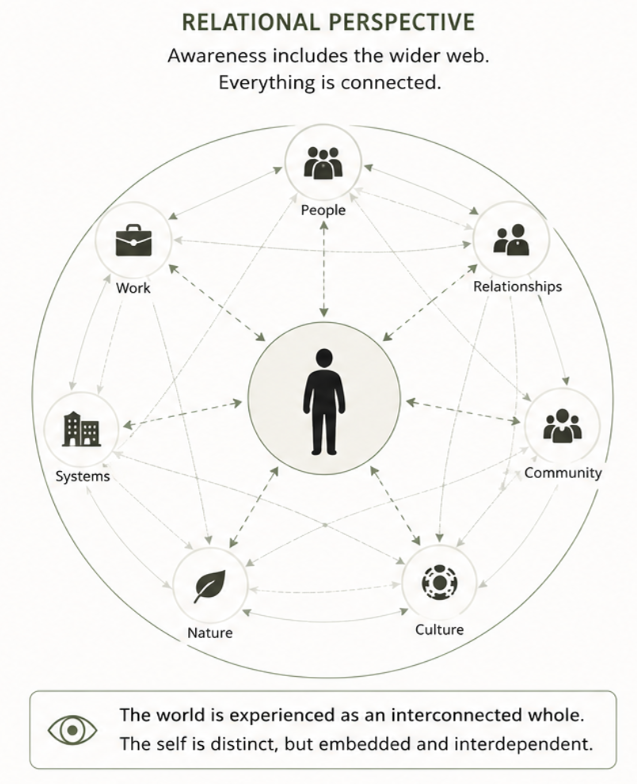
The relational perspective acknowledges connection and interdependence with others
Every person enters the world completely dependent on others:
for survival,
for emotional development,
for language,
for identity formation,
and for the development of consciousness itself.
No one becomes themselves independently. Human beings learn to think through shared language. Beliefs, emotional responses, and patterns of relating develop through interaction over time. Even the sense of self forms within relationships, systems, and shared social worlds that existed before any individual entered them.
And this dependence does not disappear in adulthood. Every human life remains continuously sustained through vast networks of:
care,
labour,
infrastructure,
institutions,
ecology,
cooperation,
and social organisation extending far beyond what any individual can fully perceive.
Even the most independent person remains profoundly dependent on:
people they will never meet,
systems they did not build,
knowledge they did not create,
and ecological conditions they do not control.
Human beings do not occasionally affect one another. They affect one another continuously. Behaviour unfolds relationally. Meaning itself depends on shared language and shared understanding. Identity develops through interaction. Actions extend outward into the lives of others whether this is recognised or not.
The relational perspective therefore involves more than recognising that relationships matter.
It involves perceiving that human existence itself unfolds within networks of interdependence and mutual influence that no person stands outside of.
This is not an ideology or moral preference. It is an observable condition of human life. The relational perspective is not something added onto reality. It is reality becoming more fully visible.
Why the Relational Perspective Falls Out of View
If the relational nature of human existence is so fundamental, an obvious question follows:
Why is it so difficult to see?
The issue is not that relational reality disappears. It is that modern life consistently directs attention elsewhere.
From early childhood, people are taught to experience themselves primarily as individuals:
responsible for their own outcomes,
managing their own lives,
pursuing their own goals,
and defining themselves through personal achievement, identity, and success.
Schooling, workplaces, economic systems, technology, and broader social structures all reinforce this orientation.
People are measured individually. Evaluated individually. Rewarded individually. Compared individually.
At the same time, the relational dimensions of life are far less visible:
how behaviour is shaped through interaction,
how systems organise possibility,
how outcomes are co-created,
how deeply human life depends on others,
and how continuously people affect one another.
These realities remain present, but modern life does little to keep them clearly in view. As a result, the individual perspective becomes sharper, clearer, and more familiar, while the relational perspective increasingly fades into the background of awareness.
This does not mean people reject connection or interdependence consciously. More often, these realities simply fail to remain fully visible in real time. And what consistently falls outside awareness cannot reliably shape perception, behaviour, or responsibility.
For men, this pattern is often intensified further through masculine socialisation that emphasises:
independence,
self-reliance,
emotional control,
competition,
and separation from vulnerability and dependence.
The result is not simply individualism as an idea. It is a way of perceiving reality in which the individual self becomes increasingly central while the relational conditions of human existence recede from view.
What the Relational Perspective Makes Visible
A relational perspective changes what becomes perceptible.
From a predominantly individual perspective, other people can easily become experienced primarily through their relationship to the self:
as supports,
threats,
validators,
obstacles,
audiences,
dependants,
or extensions of one’s own emotional world.
A relational perspective shifts this.
Other people become more fully visible as:
separate centres of consciousness,
people with their own inner lives,
emotional realities,
histories,
vulnerabilities,
needs,
and legitimate experience of the world.
But the shift extends beyond interpersonal awareness alone. As relational reality becomes more visible, it also becomes harder to experience oneself as fully separate from the wider human world.
A person begins to recognise more clearly that:
behaviour unfolds within relationships,
identity develops through interaction,
emotional life is shaped relationally,
actions affect others continuously,
and individual lives remain embedded within communities and larger systems of interdependence.
From this perspective, actions are no longer understood merely as private events affecting an isolated self. They are recognised as part of a shared human reality that extends outward into the lives of others, into relationships, systems, communities, and the broader social world.
This expands awareness beyond individual intention alone.
A person becomes increasingly able to perceive:
impact beyond intention,
mutual influence,
participation in shared systems,
dependence on others,
responsibility within relationships,
and the reality that no human being exists independently from the world around them.
The relational perspective therefore does not simply change how a person behaves. It changes how they understand what human existence actually is. The self is no longer experienced as fundamentally separate and self-contained. It is experienced as part of a larger interconnected reality that has always been there – whether fully recognised or not.
Why This Matters for Primary Prevention
If harmful patterns are partly sustained by diminished relational awareness, then prevention must involve more than behaviour regulation alone.
It must also involve relational development.
This means prevention cannot focus only on:
what men believe,
what norms they endorse,
or what behaviours they display.
It must also consider:
how men understand themselves in relation to others,
what remains outside their awareness,
how fully other people are experienced as real,
whether the interconnected and interdependent nature of human existence remains visible within their understanding of the world,
and how communities, institutions, and societies shape and sustain shared human life.
From this perspective, many harmful relational patterns can be understood not simply as failures of morality or behaviour, but as expressions of a deeper perceptual imbalance: the overdevelopment of the individual perspective without a sufficiently developed relational one.
This does not replace existing work on:
gender inequality,
power,
social norms,
or masculinity.
But it may help explain why change can sometimes remain:
fragile,
performative,
situational,
or difficult to sustain.
Because beneath many harmful behaviours sits a deeper way of understanding the self: as fundamentally separate, self-contained, and only partially connected to the lives and reality of others.
A relational perspective shifts this. It expands awareness beyond the isolated self and makes visible the wider human reality within which all behaviour, relationships, and social life unfold.
From this perspective, prevention is not only about changing behaviour. It is also about helping people perceive more fully the relational reality they have always been part of.
Beyond Masculinity
The relational perspective is not ultimately about masculinity.
Masculinity and femininity are social constructions built around deeper human realities. The deeper issue is developmental, perceptual, and existential.
Human beings exist simultaneously as:
individuals,
and participants in an interconnected and interdependent human world.
Both realities are fundamental.
Individuality matters. Agency matters. Autonomy matters.
But human beings were never separate from one another to begin with.
Every person exists within relationships, systems, structures, communities, and ecological conditions that continuously shape and sustain human life. No one becomes themselves independently. No one survives independently. No one exists outside the wider human world they are part of.
When the individual perspective becomes heavily dominant while this relational reality falls increasingly out of view, harmful patterns become more likely:
violence,
coercion,
disconnection,
loneliness,
emotional invisibility,
diminished awareness of impact,
and weakened responsibility toward others and the broader systems that sustain shared life.
The task of prevention, then, may not simply be to endlessly reconstruct masculinity.
It may be to help people perceive more fully the relational reality they have always existed within:
that their lives affect others,
that they are shaped by others,
that they depend on others,
and that human existence itself unfolds within networks of mutual influence, responsibility, and interdependence.
Because the relational perspective is not an ideology. It is not merely a moral preference. And it is not something artificially added onto human life.
It is the recognition of a reality that was already there from the beginning.