4. Beyond Masculinity
Understanding Men’s Violence Through The Social Orientation Model
Much of the work to prevent men’s violence against women has focused on masculinity.
Over recent decades, the field of primary prevention has developed increasingly sophisticated ways of understanding how gender norms, power, entitlement, and socialisation contribute to harm. We now have a much clearer understanding of the attitudes, behaviours, and social patterns associated with men’s violence.
And yet, despite this progress, change can still feel slow, uneven, and difficult to sustain.
Many men are capable of articulating the “right” ideas about gender equality while continuing to reproduce the same harmful relational patterns in practice. Behaviour change can occur in one context but disappear in another. Reflection and insight do not always translate into deeper relational change.
This raises an important question: What if masculinity is not the deepest level of the problem?
What if many of the patterns we associate with harmful masculinity reflect something more fundamental about how people learn to understand themselves in relation to others?
Over time, I’ve increasingly come to see many of these patterns not simply as matters of identity, ideology, or behaviour, but as expressions of a deeper developmental imbalance: an overreliance on the individual perspective without an equally developed awareness of relational reality.
This article explores that possibility through what I describe as the Social Orientation Model.
At its core is a simple idea: how we understand our place in the world shapes what becomes visible to us – and therefore shapes how we act.
Human beings experience themselves in two fundamentally different, but equally real, ways: as individuals, and as participants in a larger relational and interdependent human reality.
Both perspectives are necessary. The problem emerges when one becomes heavily dominant while the other increasingly falls out of view.
From this perspective, many of the patterns associated with harmful masculinity – dominance, emotional restriction, defensiveness, entitlement, control, and diminished awareness of impact – can be understood not simply as masculine traits, but as the expression of a way of perceiving the world that has become overly organised around separateness, autonomy, and the self.
This article explores how these orientations develop, why they can become unevenly balanced, how this imbalance may help explain persistent harmful patterns, and what this might mean for prevention practice.
Importantly, this is not an attempt to dismiss the importance of masculinity, gender inequality, or existing prevention work. Rather, it is an attempt to look beneath these patterns toward the deeper developmental conditions that may help explain why they emerge so consistently – and why they can be so difficult to change.
Individual Orientation
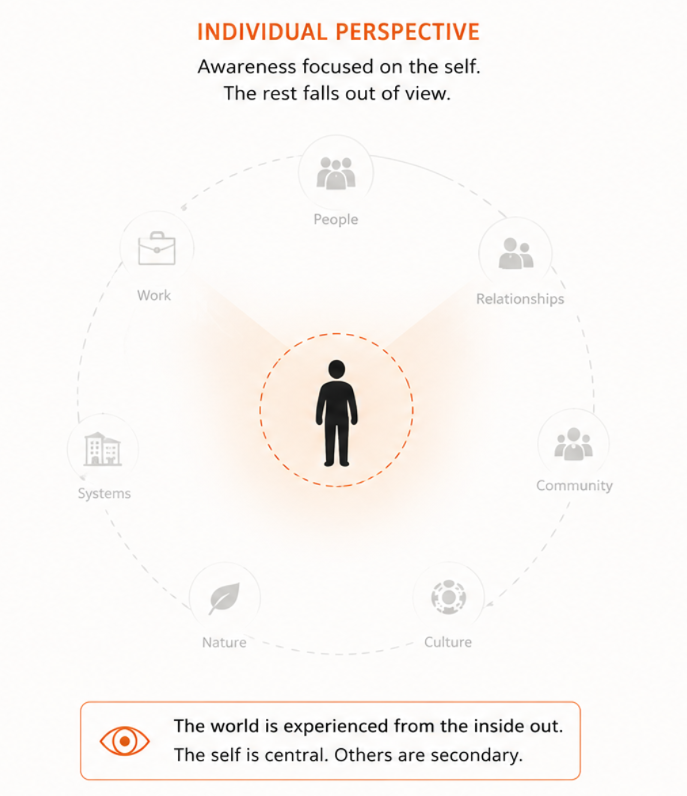
Human beings experience themselves as distinct individuals.
We each experience:
our own thoughts,
our own bodies,
our own emotions,
our own needs,
and our own perspective on the world.
From early in life, people develop a sense of themselves as separate and autonomous beings: someone who can act, choose, decide, and move through the world independently.
This individual perspective is real and necessary.
Without it, there is:
no agency,
no identity,
no responsibility,
no independent thought,
and no stable sense of self.
But this perspective also shapes what becomes most visible within experience.
When human life is primarily understood through an individual frame, the self increasingly becomes the central reference point through which situations are interpreted. Attention naturally gravitates toward:
one’s own intentions,
one’s own needs,
one’s own goals,
one’s own emotional experience,
and one’s own understanding of events.
From within this orientation, other people can gradually become experienced more through their relationship to the self:
as supports,
threats,
validators,
obstacles,
audiences,
or sources of emotional impact.
This does not necessarily emerge through selfishness or conscious disregard for others. Rather, it reflects a way of perceiving the world in which the individual self remains most visible and immediate, while the wider relational reality surrounding human life becomes less consistently apparent.
When this perspective becomes heavily dominant – without an equally developed relational awareness – people can begin to experience themselves as more separate, self-contained, and independent than they truly are. Over time, this can reduce awareness of:
mutual impact,
interdependence,
relational responsibility,
and the extent to which human life is continuously shaped by connection with others.
Relational Orientation
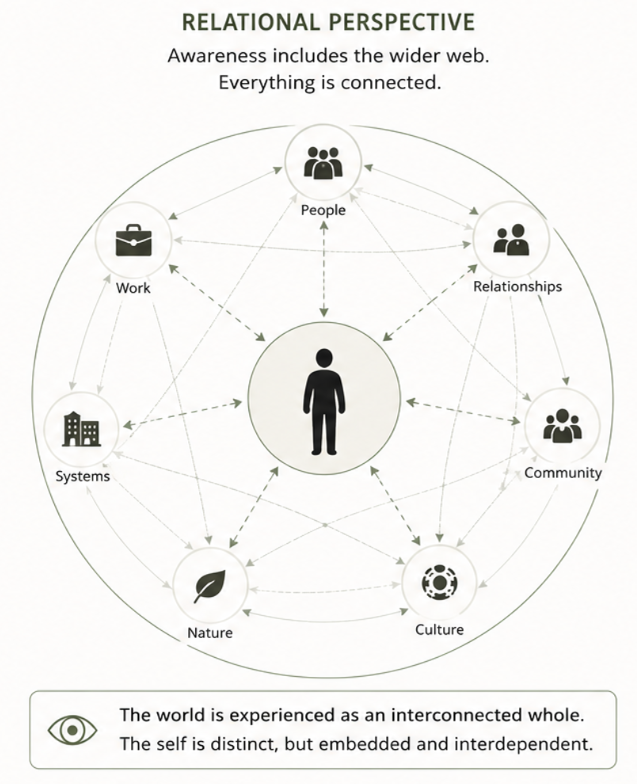
But human beings do not exist only as individuals. Human life is also profoundly relational and interdependent from the beginning.
Every person comes into existence dependent on others:
for survival,
for emotional development,
for language,
for identity formation,
and for the development of consciousness itself.
And this dependence never fully disappears.
Even the most independent person remains continuously sustained through vast networks of:
relationships,
labour,
infrastructure,
institutions,
ecology,
cooperation,
and social systems extending far beyond what any individual can fully perceive.
A relational orientation reflects the capacity to perceive this wider human reality more fully.
From within a relational perspective, people increasingly recognise that:
their lives affect others,
they are affected by others,
behaviour unfolds within relationships,
and no person exists independently from the wider social world they are part of.
Other people become more visible not simply as extensions of one’s own experience, but as fully separate centres of consciousness with:
their own inner lives,
emotional realities,
vulnerabilities,
histories,
and legitimate experience of the world.
This perspective expands awareness beyond individual intention alone. A person becomes increasingly able to perceive:
impact beyond intention,
mutual influence,
shared responsibility,
dependence on others,
and participation in larger relational systems that shape human life.
The relational perspective is therefore not simply about empathy, kindness, or emotional openness. It is a way of perceiving reality itself.
It reflects the recognition that human beings are not isolated individuals who occasionally interact with one another. Human existence unfolds within networks of interdependence and mutual influence that no person stands outside of.
This is not an ideology or moral preference. It is an observable condition of human life becoming more fully visible.
Holding Both Perspectives
Human beings do not exist exclusively in either of these orientations.
We are both:
individuals,
and participants in a larger relational reality at the same time.
Individuality is real. We each experience ourselves as distinct people with:
our own thoughts,
needs,
emotions,
agency,
and capacity for independent action.
But relationality is equally real. No person exists independently from the relationships, systems, communities, and conditions that shape and sustain human life.
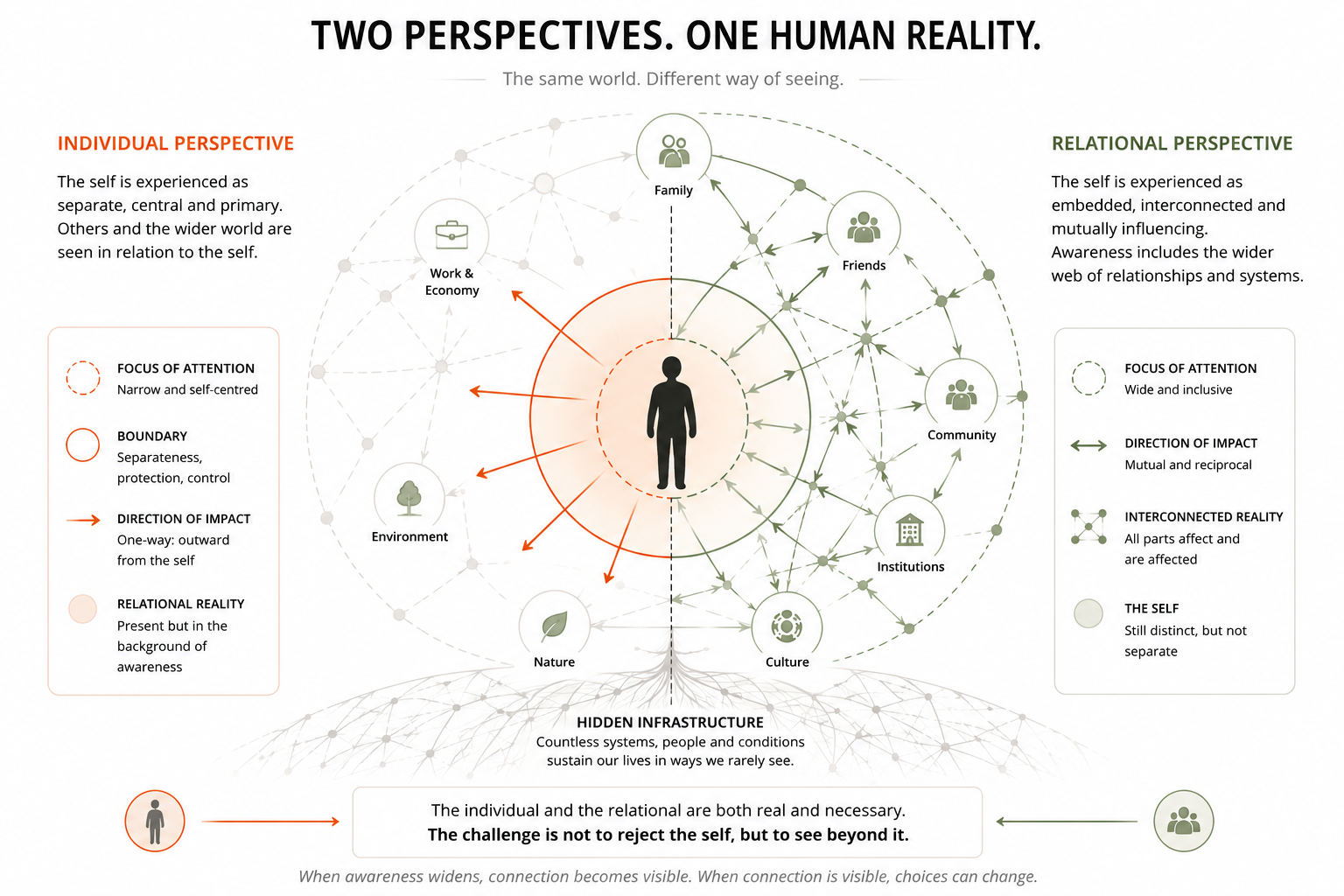
Human maturity involves the growing capacity to hold both realities in awareness simultaneously: to remain grounded in oneself while also recognising connection to others; to act with agency while remaining aware of mutual impact; to experience oneself as distinct without experiencing oneself as separate.
This balance is not a fixed achievement. It is an ongoing developmental and relational process.
The challenge is that these two perspectives do not always remain equally visible.
In many contemporary contexts, the individual perspective becomes sharper, more immediate, and more consistently reinforced, while the relational perspective increasingly fades into the background of awareness.
As this occurs, people can begin to experience themselves primarily as autonomous and self-contained individuals, while the wider relational conditions of human existence become less perceptible in everyday life.
When both perspectives remain visible together, a person is more able to:
recognise both personal agency and interdependence,
hold responsibility toward themselves and others simultaneously,
perceive impact beyond intention,
and navigate relationships without losing sight of either individuality or connection.
From this perspective, healthy development is not about dissolving individuality into the collective, nor about becoming entirely self-reliant and separate.
It is about developing the capacity to hold both human realities at once: the reality that we are distinct individuals, and the reality that we have never existed independently from one another in the first place.
When Development Becomes One-Sided
The challenge is that these two orientations do not always develop in balance.
In many contemporary contexts, development becomes heavily weighted toward the individual perspective, while the relational perspective receives far less consistent reinforcement and visibility.
From early in life, people are encouraged to experience themselves primarily as individuals:
responsible for their own outcomes,
pursuing their own goals,
managing their own emotions,
defining their own identity,
and competing for status, recognition, and security.
Schooling, workplaces, economic systems, technology, and broader cultural structures all tend to reinforce this orientation. People are measured individually, rewarded individually, compared individually, and taught to experience success and failure primarily through the lens of the self.
At the same time, the relational dimensions of human life often remain far less visible:
the extent to which identity develops through relationships,
how behaviour continuously affects others,
how emotional life unfolds relationally,
how deeply dependent human beings remain on networks of care and cooperation,
and how individual lives are continuously shaped by larger social systems and conditions.
These realities do not disappear. But they are often pushed further into the background of awareness.
As a result, the individual perspective can gradually come to feel more primary, immediate, and trustworthy, while relational reality becomes less consistently perceptible in everyday experience.
When development becomes heavily weighted in this direction, people are more likely to experience themselves as:
separate,
self-contained,
autonomous,
and primarily responsible only for their own position, needs, and emotional reality.
From within this orientation, other people can increasingly become experienced through their relationship to the self:
as obstacles,
validators,
threats,
supports,
audiences,
or sources of emotional regulation.
The issue is often not deliberate harm or conscious disregard for others. More often, it is that important aspects of relational reality become less visible in real time:
the emotional experience of others,
impact beyond intention,
mutual influence,
shared responsibility,
and the extent to which human life unfolds within interconnected systems of relationship and dependence.
Over time, this imbalance can shape how people interpret conflict, relationships, power, responsibility, and human interaction itself.
Patterns such as:
defensiveness,
entitlement,
emotional disconnection,
control,
diminished awareness of impact,
exploitation,
coercion,
isolation,
and loneliness
can all emerge more easily within a worldview that is organised primarily around separateness without an equally developed awareness of interdependence and relational impact.
From this perspective, many harmful patterns are not simply matters of belief or morality alone. They reflect what becomes easier — and harder — to perceive when one side of human reality increasingly dominates awareness while the other fades further from view.
How these orientations develop
Both orientations emerge through development.
They are not fixed personality traits, but ways of perceiving and understanding human experience that are shaped over time through relationships, environments, culture, and lived experience.
Early in life, the development of an individual orientation is both natural and necessary.
Children gradually learn to distinguish themselves from others. They develop:
identity,
agency,
autonomy,
independent thought,
and the capacity to act in the world as separate individuals.
This process is essential for healthy development.
But the development of a relational orientation is often more complex and less automatic.
Relational awareness involves more than simply interacting with other people. It involves gradually recognising that:
other people exist as fully separate centres of experience,
one’s actions continuously affect others,
emotional life unfolds relationally,
and human existence itself depends upon networks of interdependence that no individual stands outside of.
This kind of awareness tends to develop more slowly and unevenly over time.
It depends on experiences and environments that consistently make relational reality visible:
relationships where mutuality is modelled,
environments where emotional and relational impact are acknowledged,
experiences of accountability and reciprocity,
opportunities to recognise the reality of other people’s inner worlds,
and social contexts that reinforce connection and interdependence rather than separateness alone.
Without these conditions, the relational perspective can remain comparatively underdeveloped – not absent, but less accessible, less stable under pressure, and less consistently present in awareness.
In many contemporary contexts, the individual orientation receives far stronger reinforcement.
People are consistently encouraged to:
define themselves individually,
pursue personal success,
manage themselves independently,
compete for status and recognition,
and experience responsibility primarily through the lens of the self.
Meanwhile, the relational conditions that sustain human life often remain comparatively invisible.
As a result, development can gradually become uneven. The individual perspective becomes sharper and more dominant, while relational awareness receives less reinforcement and remains more difficult to sustain consistently in everyday life.
From this perspective, many harmful relational patterns can be understood not simply as moral failure or conscious intent, but as the outcome of developmental imbalance: a way of perceiving the world in which individuality remains highly visible while relational reality increasingly fades into the background of awareness.
Gender and the development of orientation
These developmental patterns are not distributed evenly across society.
In many social contexts, boys and girls are encouraged toward different ways of relating to themselves and others from an early age.
Girls are often socialised in ways that more consistently reinforce relational awareness. They may be encouraged – both explicitly and implicitly – to:
attend to relationships,
consider the feelings and needs of others,
maintain social connection,
manage emotional dynamics,
and remain aware of relational impact.
Boys, by contrast, are often more strongly reinforced toward:
independence,
self-reliance,
emotional control,
competitiveness,
autonomy,
and separation from vulnerability and dependence.
This does not mean boys are incapable of relational awareness, nor that girls naturally possess it more fully.
The issue is not biological inevitability. It is developmental emphasis.
Over time, these patterns can shape which orientation becomes more reinforced, trusted, and consistently visible within experience.
For many men, the individual perspective becomes more heavily developed and socially reinforced, while relational awareness may receive less explicit support and become more difficult to sustain under pressure.
For many women, relational awareness is often more consistently reinforced, while individuality and autonomy may historically have received less support or legitimacy.
These patterns are never absolute. They vary across individuals, cultures, relationships, and social environments.
But as broad developmental tendencies, they remain significant because they help shape how people come to perceive:
themselves,
other people,
relationships,
responsibility,
conflict,
and social life itself.
When the individual orientation becomes heavily dominant, the world is more likely to be experienced through a lens of separateness:
one’s own perspective feels most immediate,
one’s own needs and emotional reality become more central,
and the lived experience of others becomes harder to perceive consistently in real time.
From within this orientation, behaviours such as:
defensiveness,
control,
dominance,
entitlement,
emotional restriction,
and diminished awareness of impact
can emerge more easily - not necessarily because harm is consciously intended, but because relational reality itself becomes less fully visible.
This helps explain why many harmful patterns associated with violence and relational harm are gendered without reducing the issue to masculinity alone.
From this perspective, masculinity is not the deepest level of the problem. Rather, masculine socialisation can be understood as one of the ways developmental imbalance becomes reinforced and organised culturally over time.
The issue is therefore not that men are inherently less relational. It is that many men are socialised within conditions that more consistently reinforce individuality while providing fewer opportunities to fully develop and sustain relational awareness.
And when development becomes uneven in this way, it shapes not only behaviour, but perception itself – influencing what people are able to recognise, sustain, and remain aware of within relationships and social life.
Masculinity
Much of the work to prevent men’s violence against women has focused on masculinity – particularly the norms, attitudes, and behaviours associated with being a man.
This work has been essential in making visible patterns such as:
dominance,
entitlement,
emotional restriction,
defensiveness,
control,
competitiveness,
and the devaluation or diminished visibility of others, particularly women.
These patterns are real, well documented, and clearly connected to harm.
But this raises an important question:
What if many of the patterns associated with harmful masculinity are not best understood as masculinity itself, but as the expression of a deeper developmental imbalance underneath it?
From the perspective developed throughout this article, many traits associated with harmful masculinity begin to look less like inherently masculine characteristics and more like the predictable expression of a worldview heavily organised around separateness, autonomy, self-protection, status, and the centrality of the self without an equally developed awareness of interdependence and relational impact.
For example:
dominance reflects the prioritisation of the self over mutuality,
entitlement reflects the assumption that one’s own needs and perspective are primary,
emotional restriction often emerges from the need to maintain an image of oneself as strong, independent, and invulnerable,
defensiveness can emerge when the emotional reality of others remains difficult to fully perceive,
and reduced awareness of impact reflects the tendency to experience one’s own intentions as more visible and significant than the lived experience of others.
These patterns do not require masculinity to exist conceptually in order to emerge.
They can arise naturally within a developmental orientation where individuality becomes heavily dominant while relational awareness remains comparatively underdeveloped or difficult to sustain consistently.
From this perspective, masculinity may be less the underlying mechanism than the cultural structure through which this imbalance becomes organised, reinforced, and expressed socially over time.
This does not mean masculinity is irrelevant. Masculine norms, gendered socialisation, and patriarchal systems remain profoundly important in shaping:
how these patterns develop,
how they are reinforced,
and how they become gendered within society.
But masculinity may not be the deepest level of explanation. Because beneath many harmful masculine patterns sits a more fundamental issue: how human beings learn to perceive themselves in relation to others.
If a person primarily experiences themselves as:
separate,
autonomous,
self-contained,
and responsible primarily for their own position and needs,
then patterns such as control, defensiveness, emotional restriction, competition, and diminished awareness of impact become easier to reproduce – not necessarily because harm is consciously intended, but because relational reality itself becomes less fully visible within experience.
From this perspective, many current prevention approaches remain focused primarily on reshaping the expression of masculinity:
healthier masculinity,
emotionally intelligent masculinity,
vulnerable masculinity,
non-violent masculinity.
But if the underlying developmental imbalance remains largely unchanged, these approaches can struggle to produce deeper and more sustainable relational transformation.
A person may adopt:
progressive beliefs,
anti-violence values,
emotionally expressive language,
and healthier relational behaviours,
while still primarily perceiving the world through an individual frame in which:
their own perspective remains central,
relational impact remains only partially visible,
and others continue to be experienced more through their relationship to the self than as fully separate centres of experience.
From this perspective, the challenge may not simply be to reconstruct masculinity differently.
It may be to support the development of a more balanced way of perceiving human existence itself – one capable of holding both individuality and relational interdependence in awareness at the same time.
Why Current Approaches Often Stall
Efforts to prevent men’s violence against women have made profound and important contributions.
Primary prevention work has helped make visible patterns that were once normalised or ignored:
gender inequality,
entitlement,
coercion,
emotional restriction,
dominance,
harmful social norms,
and the broader systems that reinforce violence and relational harm.
This work remains essential.
At the same time, progress can often feel:
slow,
uneven,
fragile,
or difficult to sustain.
Many men become capable of articulating the “right” ideas about gender equality while continuing to reproduce the same harmful relational patterns in practice. Behaviour change can occur in one setting but disappear in another. Reflection and insight do not always translate into deeper relational transformation.
One way to understand this is through the lens of developmental orientation.
Much of the current work focuses on changing:
beliefs,
attitudes,
behaviours,
social norms,
and constructions of masculinity.
These interventions matter. But many of them operate primarily within an individual frame of reference.
Men are often encouraged to:
reflect on themselves,
examine their beliefs,
regulate their behaviour,
develop healthier identities,
and consciously adopt new norms and values.
But underneath these efforts, the underlying orientation through which situations are perceived may remain largely unchanged.
A person may intellectually reject harmful beliefs while still experiencing:
their own perspective as most immediate,
their own emotional reality as most central,
and the lived experience of others as more difficult to fully perceive consistently in real time.
From this perspective, change can become:
cognitively understood,
situationally performed,
but not deeply embodied at the level of perception itself.
This helps explain why some forms of change can feel fragile.
New behaviours may emerge in contexts where reflection and accountability are present, but become difficult to sustain under:
stress,
shame,
conflict,
emotional threat,
rejection,
or perceived loss of control.
Because under pressure, people often return to the orientation that feels most familiar, immediate, and psychologically stabilising.
If the underlying developmental imbalance remains largely intact, then the same patterns can continue to re-emerge even when the language surrounding them changes.
In some cases, prevention work may also unintentionally reinforce aspects of the same individual frame it is attempting to challenge.
Men are often asked:
What kind of man should you become?
What beliefs should you adopt?
How should you regulate yourself?
How should you perform healthier masculinity?
These questions remain heavily centred on the self as the primary site of orientation.
As a result, relationality can become something a person attempts to cognitively manage or perform, rather than something more deeply perceived and experienced as part of reality itself.
This may help explain why some men become:
highly fluent in prevention language,
emotionally articulate,
and capable of performing accountability,
while substantial relational transformation remains limited.
The issue is not necessarily insincerity. More often, the underlying orientation through which the world is perceived remains predominantly individual:
the self remains most visible,
relational impact remains partially obscured,
and others continue to be experienced more through their relationship to the self than as fully separate centres of experience.
From this perspective, sustainable change may require more than behaviour modification alone.
It may require the gradual development of a more relational way of perceiving human existence itself:
one in which:
interdependence becomes more visible,
mutual impact becomes more perceptible,
other people become more fully real,
and the self is no longer experienced as fundamentally separate from the wider relational world it exists within.
This does not mean abandoning existing prevention work. Nor does it mean replacing accountability, behaviour change, or work on gender inequality and masculinity.
Rather, it suggests that many current approaches are operating at the level of expression without fully addressing the deeper developmental conditions from which those expressions emerge.
If the imbalance is perceptual and developmental in nature, then sustainable prevention may depend not only on changing what people believe and do, but on expanding what they are able to perceive and remain aware of within human relationships and social life itself.
What This Means for Practice
If harmful patterns are shaped by developmental imbalance between individual and relational ways of perceiving the world, then this has important implications for prevention practice.
It suggests that sustainable change may require more than:
behaviour regulation,
belief change,
identity reconstruction,
or the adoption of healthier social norms alone.
These approaches remain important. But on their own, they may struggle to produce deeper relational transformation if the underlying orientation through which people experience themselves and others remains largely unchanged.
From this perspective, prevention is not only about changing what people think and do. It is also about expanding what people are able to perceive and remain aware of within human relationships and social life.
This represents a shift in emphasis: from behaviour change toward developmental and perceptual change; from modifying expression toward deepening relational awareness; from focusing solely on what people believe toward how they experience themselves in relation to others.
Importantly, this is not a fully formed model of practice. Rather, it is a different way of understanding the problem – one that raises new questions about what meaningful and sustainable change may actually require.
If relational awareness develops through lived experience rather than intellectual instruction alone, then prevention may need to create conditions where relational reality becomes more consistently visible and experientially grounded over time.
This may involve:
creating environments where mutuality and shared responsibility are required rather than optional,
supporting the capacity to recognise other people as fully separate and equally significant centres of experience,
making interdependence and relational impact more visible in everyday life,
strengthening the ability to perceive impact beyond intention,
embedding accountability within ongoing relationships rather than isolated moments of reflection,
and creating social conditions where relational awareness can be practised, reinforced, and sustained under pressure.
From this perspective, relational development cannot be confined to workshops, language, or abstract discussion alone.
A person may intellectually understand:
equality,
consent,
accountability,
emotional communication,
and anti-violence principles,
while still experiencing the world predominantly through an individual frame in which:
the self remains central,
others remain partially obscured,
and relational impact becomes difficult to sustain consistently in awareness.
This suggests that prevention may need to focus not only on reflection and education, but also on creating repeated lived experiences of:
reciprocity,
mutual influence,
relational accountability,
dependence on others,
and participation in shared human systems and relationships.
Importantly, this is not about diminishing individuality, agency, or autonomy.
The individual perspective remains essential. Human beings require:
identity,
agency,
boundaries,
independent thought,
and personal responsibility.
The task is not to replace individuality with collectivism or self-sacrifice.
The task is balance: developing the capacity to remain grounded in oneself while also remaining aware of connection, mutual impact, and interdependence with others.
From this perspective, prevention is not simply about producing “better men” or reconstructing masculinity in healthier forms.
It is about supporting the development of a more complete way of perceiving human existence itself: one capable of holding both individuality and relational reality in awareness at the same time.
Because if the underlying challenge is developmental and perceptual in nature, then lasting change may depend not only on teaching new behaviours, but on helping people experience more fully that they have never existed separately from one another in the first place.
Conclusion
The Social Orientation Model does not reject the importance of masculinity, gender inequality, social norms, or existing prevention work.
It reframes them.
From this perspective, many harmful patterns associated with men’s violence and relational harm can be understood not only as matters of ideology, behaviour, or identity, but as expressions of a deeper developmental imbalance: the overdevelopment of the individual perspective without an equally developed relational awareness.
When human beings primarily experience themselves as:
separate,
self-contained,
autonomous,
and only partially connected to others,
certain patterns become easier to reproduce:
diminished awareness of impact,
emotional disconnection,
defensiveness,
control,
entitlement,
coercion,
loneliness,
and relational harm.
This does not mean harm is consciously intended in every moment. More often, important aspects of relational reality become difficult to perceive and sustain consistently within awareness:
the lived experience of others,
mutual influence,
interdependence,
and the wider relational systems that shape and sustain human life.
From this perspective, men’s violence and disconnection are not entirely separate problems. They can be understood as different expressions of the same underlying imbalance: a way of perceiving human existence in which individuality remains highly visible while relational reality increasingly falls out of view.
The challenge, then, may not simply be to endlessly reconstruct masculinity or reshape behaviour at the level of expression alone.
It may be to support the development of a more balanced way of perceiving human existence itself: one capable of holding both individuality and interdependence in awareness at the same time.
Because human beings are both:
distinct individuals,
and participants in a larger relational world they have never existed outside of.
Both realities are fundamental. Both are necessary.
The task is not to eliminate individuality, autonomy, or agency. Nor is it to dissolve the self into the collective.
It is to develop the capacity to remain grounded in oneself without losing sight of others as equally real, significant, and interconnected participants in the same shared human reality.
From this perspective, the deeper challenge of prevention is not simply teaching people how to behave differently.
It is helping people perceive more fully the relational reality they have always existed within: that their lives affect others, that they are shaped by others, that they depend upon others, and that no human being exists separately from the wider human world that makes their life possible.
Because in the end, this may not only be a question about masculinity or men’s violence.
It may be a question about human development itself: how we learn to become ourselves without losing sight of one another in the process.