5. The Leaning Tower of Masculinity
Rethinking the Role of Masculinity in Primary Prevention
The Tower
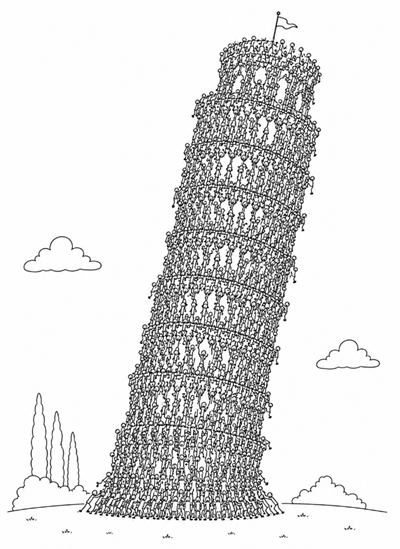
For centuries, the Leaning Tower of Pisa has stood as one of the world’s most recognisable architectural failures. Not because it collapsed. But because it never stood properly in the first place.
The tower was built on unstable foundations. As construction progressed, the structure began to lean. Over generations, engineers attempted to compensate for the imbalance – adjusting the design, reinforcing sections, correcting angles, stabilising the structure. Yet the lean remained.
The problem was never simply the construction methods. The problem was the ground beneath it.
Masculinity increasingly feels like a similar kind of structure.
For decades, society has been engaged in a continuous project of reconstructing masculinity:
traditional masculinity,
healthy masculinity,
positive masculinity,
emotionally intelligent masculinity,
vulnerable masculinity.
We critique masculinity, soften masculinity, modernise masculinity, and attempt to rebuild masculinity in safer and healthier forms.
And yet masculinity continues to feel unstable – permanently discussed as being “in crisis”.
What if the instability is not accidental? What if masculinity itself is constructed on faulty foundations?
Gendered Constructions
Historically, traditional constructions of masculinity and femininity constrained both men and women.
Traditional femininity confined women to narrow relational roles:
nurturing,
accommodating,
dependent,
emotionally responsible for others,
tied to domestic and caregiving expectations.
Traditional masculinity constrained men differently:
emotionally restricted,
self-contained,
dominant,
stoic,
independent,
disconnected from vulnerability and dependence.
Both were attempts to organise human life into rigid gendered identities.
The Feminine Transcendence
But something important happened in modern society. Women increasingly gained permission to move beyond the confines of femininity.
The feminist movement did not simply argue that women should perform femininity differently. It challenged the idea that femininity should define the boundaries of women’s lives at all.
Women could become:
assertive,
ambitious,
independent,
agentic,
leadership-oriented,
economically autonomous.
In contemporary culture, femininity is no longer widely treated as an essential condition of womanhood in the way it once was. A woman may embody traditionally masculine-coded traits without being understood as having failed at being a woman.
In many ways, women increasingly gained greater permission to transcend traditional femininity.
The Strange Exception Made for Men
But something different happened for men. When masculinity became associated with violence, domination, emotional suppression, and harm, society did not respond by encouraging men to move beyond masculinity itself.
Instead, men were told to reconstruct it.
Be masculine differently. Be healthier masculine men. Be emotionally open masculine men. Be vulnerable masculine men. Be non-violent masculine men.
The structure was criticised constantly – but never abandoned.
This creates a strange asymmetry in contemporary gender discourse. Women increasingly gained legitimacy by becoming more than feminine. Men, meanwhile, are still expected to remain organised around masculinity.
Why? Why is the solution for women understood as transcendence, while the solution for men is reconstruction?
Masculinity as a Psychological Safety Blanket
Part of the answer lies in what masculinity represents psychologically.
Masculinity has historically been organised around an individual frame of reference:
autonomy,
separateness,
control,
self-sufficiency,
invulnerability,
dominance,
independence from need.
Within this structure, relationality becomes associated with weakness:
dependence,
vulnerability,
emotional exposure,
loss of control.
As a result, many men experience the idea of moving beyond masculinity as threatening. It feels like collapse. Like surrender. Like becoming less of a man.
And because relationality has historically been coded as feminine, transcendence is often misunderstood as feminisation. So we cling to masculinity as a kind of psychological safety blanket.
But this misunderstanding reveals the deeper issue.
Moving beyond masculinity is not about becoming more feminine. It is about becoming more human.
The Faulty Foundations
The problem is not that men possess too much masculinity and need a softer version.
The problem is that masculinity itself is constructed on an imbalance between two fundamental aspects of human existence:
individuality,
and relationality.
Human beings are both autonomous and interdependent. We are distinct individuals, but we are also fundamentally shaped, sustained, and affected by our relationships with others.
Healthy development requires the capacity to hold both perspectives at once. But masculinity has historically been constructed through an over-identification with the individual perspective:
I stand alone.
I remain in control.
I do not need.
I contain myself.
I separate myself from vulnerability and dependence.
The relational perspective becomes diminished or suppressed. This is why masculinity continually leans toward:
dominance,
emotional restriction,
control,
hierarchy,
competition,
disconnection from others,
and reduced awareness of relational impact.
These are not inherently “male” traits. They are the predictable outcome of a worldview organised too heavily around separateness without sufficient relational balance.
This is the faulty foundation beneath the tower. And no amount of reconstruction can fully resolve the instability while the foundations remain unchanged.
Rebuilding the Tower
This is why contemporary efforts to reconstruct masculinity often feel contradictory. We now try to create forms of masculinity that are:
emotionally open but still strong,
vulnerable but still dominant enough,
relational but still self-contained,
caring but still masculine,
egalitarian but still recognisably male.
The field of primary prevention increasingly attempts to preserve masculinity while removing its harmful consequences. But this is like trying to straighten the Leaning Tower of Pisa without addressing the ground beneath it.
The problem is not simply the style of masculinity being constructed. The problem is the continued need to organise male identity around masculinity itself.
And this raises an uncomfortable question for prevention work. If transcendence worked for women, why is it denied to men? Why do we assume men still require masculinity as the organising structure of identity? Why are we so committed to rebuilding the tower instead of asking whether the tower itself should remain standing?
Beyond Masculinity
The answer may be that masculinity continues to feel psychologically necessary within a culture still heavily shaped by the individual perspective. Masculinity reassures men that they remain:
strong,
separate,
agentic,
controlled,
self-defining.
To transcend masculinity can therefore feel like losing the self entirely. But transcendence does not mean abandoning agency, strength, courage, or individuality. It means integrating them into a broader relational understanding of what it means to be human.
Courage is human. Vulnerability is human. Strength is human. Care is human. Leadership is human. Tenderness is human.
These capacities do not belong to masculinity or femininity. They belong to people.
The goal, then, is not to produce better masculine men. Nor is it to feminise men. It is to move beyond gendered identity structures built on separation and imbalance.
Not toward passivity. Not toward androgyny. But toward integration. Toward a way of understanding ourselves that can hold both individuality and relationality at the same time.
Because perhaps the future of prevention is not about endlessly reconstructing masculinity. Perhaps it is about helping men discover that they never needed the tower in the first place.